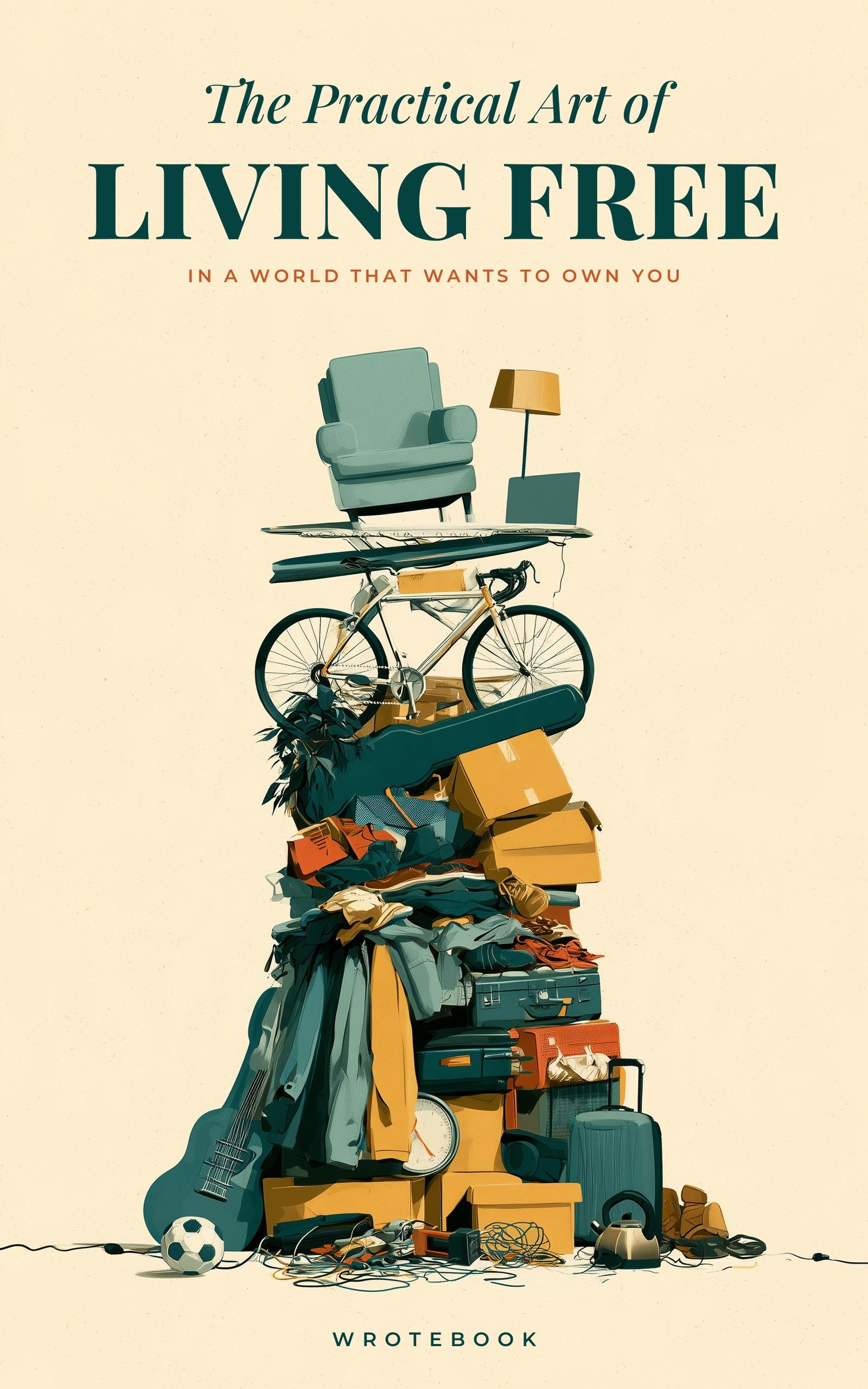
The Practical Art of Living Free
In a World that Wants to Own You
Nonfiction. 10 chapters, free to read.
How it opens
The email arrived at 4.47 on a Tuesday afternoon in late September, while Nadia Rahman was halfway through a slide she did not believe in.
About this book
A practical, humane guide to auditing money, work, possessions, home, attention and relationships, so freedom becomes something lived on an ordinary Tuesday rather than postponed, while keeping the ties worth keeping.
More from the library
All books
The Market for Your Mind
How every tech wave from television to AI learned to sell your attention.
Demo book
About The Market for Your Mind
Three Crowns of Hollowmere
A Supernatural Enemies-to-Lovers Fantasy: One City Girl, Three Shifter Princes, and a Village That Has Been Lying for a Thousand Years
K.B
7 reads0 comments
About Three Crowns of Hollowmere
Riders of the Camargue
A Montpellier police officer who ran bulls as a teenager goes undercover on a failing Camargue bull ranch after a boy is found dead in a drainage canal. Six weeks of one summer: the horses, the herd, the fêtes, and a family that starts to feel like his own.
Luc Astruc
7 reads0 comments
About Riders of the Camargue
A Stranger to My Own Dreams
A Memoir of Ambition, Heartbreak, and Learning to Forgive the Girl Who Had It All Planned
Meadow Appendix JNM
11 reads0 comments
About A Stranger to My Own Dreams
I, Eleno
The Imagined Memoir of Eleno de Céspedes — Tailor, Soldier, Surgeon, Husband
Memoir
6 reads0 comments
About I, Eleno
As Time Will Show
The Imagined Autobiography of Ada Lovelace, Countess of Lovelace
Memoir
6 reads0 comments
About As Time Will ShowChapter 1 of 10
Comfortable Captivity
Comfortable Captivity
The email arrived at 4.47 on a Tuesday afternoon in late September, while Nadia Rahman was halfway through a slide she did not believe in. It came from the head of her practice, and its subject line was a single word, "Conversation", which at her firm could mean a redundancy or a promotion and gave nothing away until you opened it.
Nadia, I'd like to put your name forward for director in the January round. Bigger team, the two London accounts, a seat at the practice table. You've been doing most of the job for a year already. Can we find half an hour on Thursday? No need to prepare anything.
She read it at her desk on the fourth floor of an office in the middle of Manchester, where she had worked for eleven of her forty-one years, and she knew what the grade paid because everybody knew: about fourteen thousand pounds a year more than she earned now. Before she reached the sign-off she had already done the sum that matters, the one that turns a salary into a month. Something under seven hundred pounds, after tax, arriving on the twenty-fifth.
The relief came before any pride did. She thought of the mortgage on the flat in Didsbury, whose fixed rate ran out in the spring, and of the car on finance in the residents' bay, which she drove at weekends and paid for daily. Underneath the arithmetic was an older feeling, one she had carried since she was a student counting coins for the bus, and which no payslip had ever persuaded to leave. Money, for Nadia, had never really been about what it bought. It was the distance between her and the edge, and here was somebody offering to move the edge back by seven hundred pounds a month.
What the email left out she could supply herself, having watched directors for a decade. The two London accounts meant the 6.15 to Euston on Tuesdays and Wednesdays and whichever train was still running when the client had finished talking. The seat at the practice table meant a call with the American partners at nine at night, twice a month, taken in the kitchen with the door shut. The bigger team meant eleven people's appraisals, sick notes and resignations. The directors she liked best answered messages on Sunday afternoons without appearing to notice it was Sunday, and one of them had told her, as a funny story, about eating a slice of his daughter's birthday cake from a napkin on the last train north.
None of which made the offer a bad one. It was generous and kindly meant, and it came from a man who had backed her for years. Her mother would tell the neighbours. Her sister would tell her to bite his hand off. And she had, as the email said, been doing most of the job already, so that refusing would feel like declining to be paid for work she had finished. Had the offer been foolish she could have dealt with it by five o'clock. Its reasonableness was the difficulty. Hardly anyone is captured by an obvious mistake; the usual instrument is a sensible offer, accepted on its merits, on top of all the sensible offers accepted before it.
She did not reply. She finished the slide.
In Bristol the same Tuesday made no particular demands on Callum Reid, which was how he had arranged things. He was thirty-four and built websites for whoever was paying that month. He rented a room in a shared house in Easton on a rolling agreement, a month's notice either side, and owned nothing that would not fit in a hatchback, which he did not own either. One client had gone quiet; another would turn up. He worked until two, cycled down to the harbour, cycled back. For nearly two years he had been seeing Sam, and for most of the second year Sam had been asking, at lengthening intervals and with shortening patience, where the two of them stood. Callum's answers were warm and contained no information. Late at night he looked at stone cabins for sale in the hills of rural Portugal, each with a terrace, a well and a nearest neighbour who was mostly a rumour, and saved the good ones to a folder. He had been adding to the folder for three years.
Jo Hartley's Tuesday, in Sheffield, began at ten past six with a text from her mother, who could not find the tablets Jo had put in the labelled box on Sunday, and ran from there through two packed lunches, a missing PE kit, thirty Year Nines and An Inspector Calls, a lunchtime duty in the rain, a call to the surgery made from the stationery cupboard, a department meeting, the big shop, twenty minutes' drive to her mother's bungalow to find the tablets (in the labelled box), tea for three at home, and sixty-two essays on Lady Macbeth, of which she marked nineteen before falling asleep on the sofa with the pen in her hand. She was fifty-two. She had two teenagers, Ella and Ben, a three-bedroom semi with a mortgage and a temperamental boiler, and a mother of seventy-nine, Pat, who lived alone and needed a little more each month than she had the month before. If you had asked Jo that evening whether she felt free she would have laughed, not unkindly, and asked whether you could do Thursday's pick-up.
Nadia, Callum and Jo are composites, not real people. They are assembled from patterns common enough in British lives that you will probably recognise somebody in each of them, and their job is to illustrate; whenever this book says something about how people actually live, it will rest on surveys and studies, named and dated, and never on these three.
Put them beside one another and they share almost nothing except the condition this book is about. All three are free in every sense a lawyer or a historian would recognise. Nobody can compel Nadia to take the job, or Callum to stay in his room, or Jo to drive across the city with a pharmacy bag on the passenger seat. They live in a rich country, with rights their great-grandparents lacked and more choice in one supermarket aisle than most of history offered in a lifetime. And each of them, on an honest evening, would admit that their days do not quite belong to them.
So the book has one question, and it can be put to anything from a coat to a career: what has a hold on you, and did you consent to it?
The first half is easier to answer than it looks, because holds leave evidence. They show up in bank statements and calendars, in the cupboard you avoid opening, in the name on a screen that makes your stomach drop. The second half is harder, because consent comes in grades. Some of what holds you, you chose with your eyes open and would choose again tomorrow. Some you chose once, for reasons that have since expired. Some you never chose at all: it arrived by inheritance or by default, or it built up a little at a time while you were busy, the way limescale does. And some you keep only because you are afraid of what letting go would say about you. From the outside these are indistinguishable, since one direct debit looks much like another, and telling them apart is most of the work that follows.
There are two well-worn ways of getting it wrong, and Nadia and Callum have obligingly taken one each.
Hers gives this chapter its name. Comfortable captivity is what happens when a life is assembled entirely out of good decisions. The job grew, so the flat could; the flat came with a mortgage that needed the job; the commute suggested the car, the car its finance, and the long weeks their compensations, which were a cleaner, a great many takeaways and holidays booked in a hurry because she had earned them. No link in the chain was foolish and several were wise. But each one raised the price of her month, and a month that costs more has to be paid for with more of her, until an arrangement meant to support her life has become the thing her life is for. Captivity of this kind produces no crisis, and so nothing ever forces the issue. From outside it looks like success. From inside, on most days, it just feels like being tired.
Callum has made the opposite arrangement and suspects it of being the answer. Drift keeps every cost low and every door open: the tenancy that can end in a month, the work that can be turned down, the relationship that has never been given a name and so cannot be failed at. Its pleasures are real. There is air in a life like his, and time, and no dread on a Sunday night. What it lacks is accrual. Nothing in it compounds, because compounding needs something left in place for years, whether a street where you are known, a skill pursued past the point where it is still fun, or a person who has seen you at your worst and stayed. The folder of cabins is drift in its purest form, a door kept permanently ajar, admired for three years and never once walked through.
The two conditions regard each other with longing. On her worst evenings Nadia prices up a life like Callum's: sell the flat, clear the finance, six months somewhere warm with a laptop. On his, Callum watches a friend leave the pub early because he is expected at his in-laws' the next day, and feels something uncomfortably close to hunger. Each believes the other has got out. In truth they hold the same mistaken idea from opposite ends, which is that freedom means the absence of weight. Nadia thinks she has too much of it ever to be free, and Callum thinks that having almost none amounts to the same thing as being so.
Jo is the correction to them both, though she would be astonished to hear it. Her life is the heaviest of the three, and nearly all of the weight is people. Remove it and what remained would not be free; it would be bereft. A life that holds together has mass in it: people who rely on you and on whom you rely, a place that would notice if you left, work or craft that takes a decade to do properly, promises kept on the days when keeping them is a nuisance. Weight of that kind shapes a life much as gravity shapes a planet, and a life with none of it does not so much float as disperse. The aim, then, is to move from the gravity that merely accumulated to the gravity you would choose, and this book has a name for the second kind. Chosen gravity means the ties, duties, places and people you have looked at honestly, decided to keep, and go on tending. Jo's trouble is that hers arrives without limits and without help, which is a different problem from having too much love, and has different remedies.
Something should be said plainly before going further. All this can sound like a difficulty reserved for people with options, and a good deal of what gets written about living with less is exactly that: advice from the comfortable on the spiritual benefits of a smaller wardrobe. Many readers have very little room. The rent is whatever the landlord says it is; the job is the one that was going; the person who needs care needs it tonight. Nothing here asks you to pretend otherwise, and nothing here treats having little as a kind of virtue. But freedom is not a luxury product either. When a life has almost no slack in it, knowing exactly which obligations are fixed, which could be renegotiated and which you carry out of habit or fear is worth more, because every hour and every pound recovered has further to go.
What the book offers in return is modest and practical. There is an audit, eight questions that can be asked of anything with a hold on you. There are practices, tried in turn on possessions, hobbies, money, work, home, attention, other people and place, and tested each time against the three lives you have just met. And there is a permission that cuts both ways: to put down what you never agreed to carry, even when everyone you know is carrying the same, and to keep what matters to you, however heavy, without apologising to anybody's idea of simplicity. What it withholds may be as useful to know. There is no aesthetic here, no white room with one beautiful chair in it. There is no purity test, and no number of possessions below which you qualify. And early retirement will not be offered as salvation, although the people who are staking their thirties on it get a chapter of sympathetic attention.
Nadia, meanwhile, went home. She took the tram to Didsbury, ate what was in the fridge standing up, and opened the laptop at the kitchen table a little after nine, meaning to answer the email before it could follow her to bed. She wrote Thank you, I'd be delighted and looked at it. She deleted delighted and tried very glad, then deleted that too, and wrote a longer version explaining that she was honoured and would welcome the conversation, which sounded, when she read it back, like a letter from her own solicitor. For a while she did nothing. Somewhere below, a neighbour's washing machine went into its spin. Then she discarded the draft, went back to the inbox, and did the one thing about it she felt sure of, which was to mark the message as unread, so that in the morning it would be waiting at the top of the list in bold type, as if it had only just arrived and nobody had yet been asked anything.